Friday, February 12, 2010

Squirrels & Pine Martens


There are advertisements in the Shinrone area asking for information about red and grey squirrels and the elusive pine marten. A group is trying to collate information about these three species, of which two might be considered native to Ireland. The story is well-enough known. Red squirrels thrived here for centuries, but have been under threat ever since their grey cousins were introduced from America. Gradually the reds have been pushed back, clinging to ever smaller pockets of territory while the more aggressive greys expanded their range and took over the prime sites. It is hoped that the Shannon will provide some sort of barrier to the western spread of the greys, but by and large the outlook for the red squirrel is not good.


Now it seems as if the pine marten may be helping to restore some sort of balance. Its numbers are rising and they are serial hunters of grey squirrels, providing a much-needed natural predator to keep numbers under control. Information is sought from people who have seen all three species living, and hence interacting, in the same neighbourhood.


Squirrels are rodents, of which there are about 2,000 known species, including rats, mice, marmots, prairie dogs, beavers, voles and moles. About 40% of mammals are rodents and they are some of the most successful breeders and colonisers on the planet, moving in to just about every habitat you can think of. Red squirrels are among the most endearing. They make a nest or “drey” and are imperfect and erratic hibernators, driven inside to sleep only in severe weather. They rarely spend the whole winter in a state of coma, but will often pop out to look for nuts they have buried in their winter store.


Squirrels hurriedly dig shallow holes, in which they will deposit a nut, usually hazel nuts or acorns. The process is haphazard and unmethodical, and there is no reason to suppose that they ever recover more than a small proportion of what they have buried. This is almost certainly a major reason why oak trees tend to grow in unexpected places (along with the less pleasant bowel habits of horses and pigs). Our squirrel will smooth the soil over the hastily buried nuts, and then moves on to a new site until a vast store is laid down throughout the woodland to see him through the coming winter.


The more aggressive grey squirrels are an alien introduction from America, and they lack the plumed ears, grace and fascination of our native reds. They have gained a bad reputation as thieves, snatching what they can from bird tables and birds’ nests. They have been remarkably successful in spreading far and wide across Ireland, and once they move into an area, you will not see much of the downtrodden reds.


The pine marten is a handsome cat-like creature. They are mustelids, related to badgers, otters, mink and weasel. Pine marten numbers were driven to the brink of extinction because of the cutting down of forests and woodland. They are by nature arboreal (tree-dwelling) but have been forced to ground level and have learned to adapt by taking on a totally new way of life. This tree loving beast of the old woodlands and pine forests is now a raider of hen houses and underground hunter. Ducks, hens, rabbits and rats are all favourites of this highly carnivorous hunter. Nothing is safe from them. They will search the tree canopy for nests and eggs, burrow into rabbit holes, grab fish, frogs, newts and lizards out of streams and ponds. Insects and berries are also favourites.


Reafforestation has played a major part in the growth of pine marten populations in Ireland and Scotland. Legal changes give them much needed protection, not least by stopping the use of the terrible gin traps that were once far too common in the countryside and nearly exterminated this much needed predator. Nature needs a balance of species, and a flourishing pine marten population will help to control rats and grey squirrels. If you can provide information about these three species, contact us at Cabragh Wetlands and we will pass it on - cabraghwetlands@eircom.net, or telephone 0504-43879. Visit our website at www.cabraghwetlands,ie.

Thursday, February 4, 2010

Using our Earth wisely


In 2005 the United Nations published a landmark study called the ‘Millennium Ecosystem Assessment’ It stated that ‘everyone in the world depends completely on Earth’s ecosystems for food, water, disease management, climate regulation, spiritual fulfilment and aesthetic enjoyment’. While that may seem obvious, our behaviour sometimes appears to put the earth’s systems under unreasonable strain. Our extractive economy is stretching the resilience of the planet’s resources to near breaking point. So to be reminded that we all depend completely on our earth’s systems does make sense.


The study found that we are using 60% of available resources unsustainably, notably fresh water and marine fisheries, and it concluded ‘over the past 50 years humans have changed ecosystems more rapidly and extensively than in any comparable period of time in human history, largely to meet rapidly growing demands for food, fresh water, timber, fibre and fuel.’


This has resulted in a substantial and largely irreversible loss in the diversity of life on earth. The distinguished primatologist Jane Goodall has written recently that mankind is causing the sixth mass extermination of species in the history of the planet, and that it is probably unstoppable. So while one part of the UN study affirms that everyone (and everything) in the world depends completely on earth’s ecosystems, the same study is confirming that we are using these resources in an unsustainable way – indeed we destroying the life-support systems that created and support us.


We all have to budget in order to live. Imagine trying to run a house where the weekly shop is €300 and the weekly income is €200.Soon enough action would have to be taken to balance the books.


The bigger budget of the earth is really no different. Currently we are using up what the planet can produce by September of each year. From then until December we are dipping into the earth’s reserves. Unless the deposit account is very large we all know we can only dip into it for so long. There are adjustments which we need to make and it is well within our capacity to respond. The first steps are to acknowledge that there is a problem and that business as usual is not an option for us or our children.


By putting our heads together and working together we can begin to work within earth’s budget, but we do need to give it our attention. That is what we are trying to encourage at Cabragh Wetlands. We encourage you to share your thoughts, offer your advice, respond to our efforts and to get involved. Thoughts for these articles will also be passed on and used whenever possible. Contact us via e-mail at cabraghwetlands@eircom.net and visit our website at www.cabraghwetlands.ie.

Tuesday, January 26, 2010

Water Rails


The water rail is one of the most elusive birds, rarely seen but often heard by those who frequent secluded, marshy ground. If you want to see them, patience is a useful virtue. Photographers Eamonn Brennan and Joe Byrne spent many hours one Sunday in early January, waiting in the hide at Cabragh Wetlands for the shy little creature to walk into their camera lenses. Several times the bird was on the point of emerging, when something would scare him back into the undergrowth – perhaps a family walking round the ponds, or someone approaching the hide a little too noisily. With a sigh of resignation and infinite patience, Eamonn and Joe settled down to wait all over again and in the end were rewarded with fine pictures of this mysterious and secretive bird.


The water rail is closely related to the moorhen and coot family, with the very rare corncrake and bittern as cousins. It is slightly larger than a garden thrush, with a pointed red and black wader’s beak, long legs and toes, a tail cocked upwards like a wren, and a rather sideways-flattened body, which apparently makes it easier to escape into thickets of tangled grass. His back, head, wings and tail are sandy-brown, speckled black, while his flanks are striped black and white, and his chest ash-gray. Male and female are almost identical.


The call of the water rail is very hard to pin down. Its piercing cry has been likened to squealing piglets and “heart-rending and fearsome groans”, but they can also purr like a cat and croak like a frog. They buzz, grunt, screech and squeak, “their wheezy grunting (is) the sort of noise a hedgehog makes when grubbing in the dusk” and on occasion they can reverberate like a klaxon horn, or even sound “like a recalcitrant cork being repeatedly and forcefully drawn from a bottle”. For those of you still uncertain what it sounds like, this description should clarify things for you: “… incessantly uttered purring noise likened to the purring of a contented squirrel”. That’s clear, then!


The water rail is so elusive, that in effect he is routinely invisible. But where you have marshy ground, reed beds, sedge and ditches, there is every chance that they will thrive. The more tangled the undergrowth the better. Cabragh Wetlands are ideal for them, with perfect cover in the thick vegetation. Their movements have an almost rodent-like character as they scuttle into a thicket or drain. Their nests are normally deep in a sedge tussock or on watery vegetation, with seven to ten eggs laid in May and June. After three weeks of incubation by both parents, they hatch. If there is danger, the female has been known to carry her nestlings in her beak, one by one, to safety. The young can fly at about two months old.


In general they eat anything, using that long beak to dig out earthworms and catch small fish and crustacea, beetles, water boatmen, leeches, earwigs, watercress roots, seeds from grass and weeds. One was trained to jump for worms from the end of a fishing rod! They also eat caddis flies, which will not be popular if they finish off the two very rare species living in Cabragh Wetlands and nowhere else in Ireland! In weather as bad as we have experienced recently, they can be more obviously predatory. Nine bird species are known to be prey to the water rail. It has two methods of attack; firstly it will seize its victim and hold it under the water till it drowns, and secondly it will use that long slim beak as a sword, driving it through small victims like the wren and impaling them. Quail and greenfinch have been recorded as prey. It seems that this sort of aggression is so out of character that other birds do not anticipate an attack and thus are relatively easy victims.


A rare but very valued resident of Cabragh Wetlands, there are no more than a few thousand pairs of water rail in Ireland and Britain. We must preserve their habitats.

Saturday, January 9, 2010

Cold Weather


There is something special about this bitterly cold spell; it is the sort of winter that creates lifelong memories in the minds of children. Those of us of a certain age remember the great freeze of 1963, when the rivers froze over and ponds and lakes became skating rinks. Toboggans came out (how many own one today?), mass snowball fights replaced football on the school timetable until the snow became dangerously icy, spades were issued instead and we were sent to chip ice off roads and pavements. A colleague at work was recalling today how her father walked across the frozen surface of Lough Derg, and sea ice formed off the coast of Donegal. We have not quite reached those temperatures yet, but there is still plenty of time for snow to fall.


Here at Cabragh the ponds are covered in ice, and the ducks are very grateful for any food put out for them. If they can keep their feathers clean, healthy birds will cope well with these low temperatures. Have you noticed how large many of them seem at the moment? Their puffed-up feathers provide wonderful layers of insulation. Please do your best to keep feeding the birds – you will be rewarded with great entertainment around your bird table if the supply is regular and reliable.


Are your New Year resolutions still intact? We all have good intentions, but it is so easy to lapse. May we with humility suggest a few late but easily-kept resolutions for 2010?


1. Use the car less. See if you can phase out a few unnecessary car-miles by car-pooling to work or on the school run. Walk and cycle more.

2. Think about how you can save energy at home, perhaps by turning down the heating a degree or two and wearing an extra layer of clothing, insulating the loft more effectively, phasing out non-essential power-guzzling appliances.

3. Find out about alternative ways of heating and powering your home. Start yourself thinking about how best to replace your heating system with something more sustainable. What you have will not last for ever, and fossil-fuel systems will be very expensive in a few years.

4. Recycle more, and compost your organic waste. If you have young children, get them to take responsibility for some element of your environmental management.

5. Grow more food for your family. Pots and growbags will do the job if you lack garden space.

6. Look at your property and see what you can do to encourage wildlife and biodiversity. Certainly reduce chemical usage, (the frost will have killed off large numbers of slugs, so they will be less of a problem in 2010), and leave a few untidy areas - some rotting logs and a nettle patch would be ideal. Ask about which plants will attract friendly insects and birds.


If we all make small changes in our habits and lifestyles, and educate ourselves to think differently about the environment, it will make a difference to the future of the Earth.

Friday, December 18, 2009

Winter Visitors


Our countryside is inundated with thousands of visitors flying in from the northern regions of continental Europe. These ‘tourists’ spread themselves in loose flocks over the greener fields and bushier hedges. They are known as the ‘winter thrushes’. Older people called them ‘siocáns’, meaning ‘the frost birds’ as their arrival coincides with a drop in temperatures and the beginning of the winter frosts, so this is the perfect week to give them a few moments’ thought. The siocán is actually a fieldfare - a bird somewhat bigger than a blackbird. The first sign of its arrival may well be the quick cackle of its flight call – sounding like ‘cack-cack-cack-cack’. This is delivered as it flies high above the tallest trees. It is a striking bird with a grey head and rump, dark brown back and wings, spotted breast and black tail and wingtips.

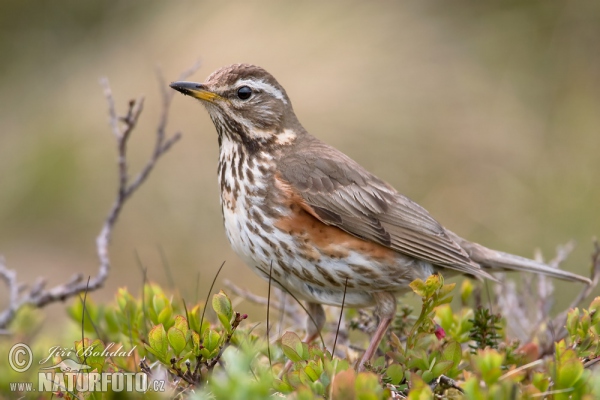
Its cousin the redwing is often the more numerous, traveling in large flocks and staying in close contact with each other. This smaller bird is very like a songthrush, but can be distinguished from it by the noticeable cream-coloured stripe above the eye. There is also a reddish patch under the wing which is very conspicuous in flight and which gives it its name. Even at night it can be identified as it flies overhead by its high pitched ‘tzeep’ call. Its Irish name is appropriately ‘deargán sneachta’ –or ‘the red snow bird’.

Neither of these thrushes breed here, but for the winter months watch out for them loosely scattered over the greener fields, hopping along and pausing now and again to pick up a tasty worm or other invertebrate. Fieldfare and redwing are often to be seen helping themselves to the bright red berries of hawthorn, yew and rowan. If you have had your eye on a beautiful sprig of holly flush with red berries for the Christmas decorations, only to go out one day and found it stripped bare, there is a good chance that the redwing or fieldfare have beaten you to it! They seem to be a lot more numerous this year. Their coming south equates to us heading off to the Riviera for a winter break!

May we at Cabragh Wetlands wish you all a very happy and peaceful Christmas, and take this chance to thank the many people who have supported our work over the course of the year.

Monday, December 14, 2009

Adaptation

Fr. SeánMcDonagh SSC December 10, 2009.

Last year at the Climate Change Conference in Poznan, Poland, I wrote an article about the importance of prioritizing the Adaptation Fund in any overall climate agreement. I made the point that reducing greenhouse gas emissions is the primary goal of the whole process. According to Article 2 of the UNFamework Convention on Climate Change (UNFCCC) the ultimate goal of the Convention is to achieve the “stabilization of greenhouse gas concentrations in the atmosphere at a level that would prevent dangerous anthropogenic interference with the climate system”.

However, it is important to remember that we are not talking about what may, or may not happen, in the future. In the 20th century average global temperatures increased by 0.74 degree Celsius, while sea-level rise, resulting from both the thermal expansion of the ocean and melting of ice across the globe, amounted to 17 cms. Even with a relatively small increase the Maldive Islands, several Small Islands states in the South Pacific and low-lying coastal nations such as Bangladesh, with lands surfaces barely a metre or two above sea level, would find that every storm and tidal surge represents a serious danger to human life. In fact, these areas may soon have to be abandoned by humans because they can no longer sustain human life.

So, Adaptation is designed to deal with the current and future casualties of climate change. From an ethical perspective it is about applying the moral principle that “the polluter must pay for the consequence of the pollution they cause.” Unless economically rich countries in Europe, North America, Japan, Australia and New Zealand and current major polluters such as China, India, Brazil and South Africa reduce greenhouse gas emissions within the next decade, then catastrophic climate change is almost inevitable and it will affect the poor more severely. Because Columbans are missionaries, much of our work on Climate Change is focused on the Adaptation measure because these will intimately affect people in many countries in which Columbans work, namely, Peru, Chile, Pakistan and the Philippines.

The Fourth Assessment Report from the Intergovernmental Panel on Climate Change (IPCC), was published in 2007, before the Bali Conference. One could summarize its finding with a few quotations from the document. It claimed that “Warming of the climate system is unequivocal as is now evident from observations of increases in global average air and oceans temperatures, widespread melting of snow and ice and rising global sea levels.” It goes on to link these changes with human activity, mainly the burning of fossil fuel to power our industrial economies, since the beginning of the industrial revolution,. “Most of the observed increase in temperatures since the mid-20th century is very likely due to the observed increase in anthropogenic greenhouse gas concentrations”.

Adaptation Fund received a lot of attention at both the Nairobi meeting of the UNFCCC in November 2006 and the Bali meeting in 2007. Disagreement centred around where the Fund would be located and how it would be managed. Economically rich countries wanted to have the Fund located in the IMF/World Bank complex, which would make it easier for them to control. This was anathema to many people from the South who suffered massive economic shocks as a result of the Third World Debt crisis in the 1980s and 1990s. Instead of attacking the banks that loaned the money or the governments that raised interest rates, the IMF/World Banks forced destructive Structural Adjustment Programmes (SAPs) that often crippled the education, health care and welfare systems of economically poor countries.

While the architecture of the Adaptation Fund was finally agreed at Bali, the main problem that Copenhagen has to tackle is simply that the needs are great and there is little money in the kitty. It is estimated that at least $100 billion annually will be needed by 2020.

A favourable outcome Copenhagen would involve: Firstly, a shared vision on Adaptation itself, which would take on board all aspects of the Bali Action Plan. This would mean a massive increase in designing Adaptation plans at the national and international levels. Secondly, rich countries must fulfill the promises they made 8 years ago to fully fund the actions which will address the immediate impact of climate change between now and 2012, when the Kyoto Protocol runs out. Thirdly, Adaptation funding must be new and additional to the Official Development Assistance (ODA) commitment of 0.7% of Gross Domestic Product (GDP) which the UN has called on all rich countries to make. The money must be delivered as grants and not as loans.

Setting the Stage for Copenhagen

Rev. Seán McDonagh, SSC December 8th 2009

This is my fourth time attending the Conference of the Parties (COP) to the UN Framework Convention on Climate Change (UNFCCC). My first one was COP 12, which took place in Nairobi in 2006. About 5,000 people were present at the event, including country delegates, people from civil society organisations and the media. We all gathered at the headquarters of the UN Development Programme (UNDP) in Nairobi. Security was tight and all events closed down before 6 p.m. I stayed at the Maryknoll house which is situated just outside Nairobi. As far as I can remember the only Head of State who attended, the president of Kenya.
The following year, COP 13 took place on the beautiful island of Bali in Indonesia. It was housed in a complex of luxury hotels close to the beach. Because of the nightclub bombings in Bali some years previously, security was very tight. About 8,000 people attended among them two heads of State, the President of Indonesia and the, then, newly elected Prime Minister of Australia, Kevin Rudd. The most memorable moment in Bali meeting happened on the last evening when the US delegation was attempting to derail what became known as the Bali Road Map. In exasperation a negotiator from the republic of Vanuatu called on the US delegation to, at least get out of the way, if they did not want to be party to the negotiation process. The Bush Administration was opposed to any globally binding climate change agreement. The Bali Road Map set out the programme of work which would have to be completed in order to deliver a follow-up treaty to the Kyoto Protocol at Copenhagen in 2009. The reason why a robust treaty is essential here at Copenhagen is that the Kyoto Protocol expires in 2012.

COP 14 took place at Poznan in Poland, in December 2008. I stayed at Capuchin monastery in the centre of the old city. On the first night one of the friars brought me for a tour and of the Christmas markets. I was particularly drawn to the ice sculptures, especially the intricacies of many of the designs. The Friar explained that traditionally these sculptures were carved in December and usually lasted through out the winter. In Poznan in December 2008, most of the sculptures had melted by the first Sunday of the Conference, a sure sign that climate change is already a reality. One of the disappointments of the Poznan’s meeting was the fact that European Union drew back from the commitments it had given at Bali, which was that rich countries, Annex 1 countries in the language of the COP, would reduce greenhouse gas emissions by between 25% to 40% by 2020. The row-back was as a result of pressure from the coal industry on the Polish governmentj and the fact that Chancellor Angel Merkel of Germany was facing re-election in 2009. She did not want to alienate the car, steel and coal constituency.

It is estimated that there will be 15,000 people at the Copenhagen Conference, including 100 Heads of State. The opening ceremony took place on December 7th 2009. It was addressed by the Prime Minister of Denmark, Mr. Lars Lokke Rasmussen, He said that COP 15 was taking place at a time of unprecedented political good will. He urged the parties to reach an ambitious agreement in order to deliver “hope for a better future” for all.

He was followed by the Executive Secretary of the UN Framework Convention on Climate Change, Mr. Yvo de Boer. He hoped that Copenhagen would result in an agreement on significant elements of the on-going negotiations. These include: Mitigation, which means cutting carbon emissions drastically in rich countries: Adaptation which involves making financial resources available to economically poor countries which are now and, in the future, will be badly effected by climate change; Initiatives to protect forests as carbon sinks and to make clean, non-fossil fuel technologies available to countries in Africa, South Asia and Latin America are also part of the negotiations. He emphasised that Copenhagen would be successful only if it delivered significant and immediate actions, beginning the day the conference ends
Madame Ritt Bjerregard, the Mayor of Copenhagen highlighted the Copenhagen Climate Summit for Mayors which will take place from December 14th to 17th 2009. She said that the city of Copenhagen aimed to be carbon neutral by 2025. She called on the negotiators to “go very far and very fast” and turn Copenhagen into “Hopenhagen.”