Tuesday, January 26, 2010

Water Rails


The water rail is one of the most elusive birds, rarely seen but often heard by those who frequent secluded, marshy ground. If you want to see them, patience is a useful virtue. Photographers Eamonn Brennan and Joe Byrne spent many hours one Sunday in early January, waiting in the hide at Cabragh Wetlands for the shy little creature to walk into their camera lenses. Several times the bird was on the point of emerging, when something would scare him back into the undergrowth – perhaps a family walking round the ponds, or someone approaching the hide a little too noisily. With a sigh of resignation and infinite patience, Eamonn and Joe settled down to wait all over again and in the end were rewarded with fine pictures of this mysterious and secretive bird.


The water rail is closely related to the moorhen and coot family, with the very rare corncrake and bittern as cousins. It is slightly larger than a garden thrush, with a pointed red and black wader’s beak, long legs and toes, a tail cocked upwards like a wren, and a rather sideways-flattened body, which apparently makes it easier to escape into thickets of tangled grass. His back, head, wings and tail are sandy-brown, speckled black, while his flanks are striped black and white, and his chest ash-gray. Male and female are almost identical.


The call of the water rail is very hard to pin down. Its piercing cry has been likened to squealing piglets and “heart-rending and fearsome groans”, but they can also purr like a cat and croak like a frog. They buzz, grunt, screech and squeak, “their wheezy grunting (is) the sort of noise a hedgehog makes when grubbing in the dusk” and on occasion they can reverberate like a klaxon horn, or even sound “like a recalcitrant cork being repeatedly and forcefully drawn from a bottle”. For those of you still uncertain what it sounds like, this description should clarify things for you: “… incessantly uttered purring noise likened to the purring of a contented squirrel”. That’s clear, then!


The water rail is so elusive, that in effect he is routinely invisible. But where you have marshy ground, reed beds, sedge and ditches, there is every chance that they will thrive. The more tangled the undergrowth the better. Cabragh Wetlands are ideal for them, with perfect cover in the thick vegetation. Their movements have an almost rodent-like character as they scuttle into a thicket or drain. Their nests are normally deep in a sedge tussock or on watery vegetation, with seven to ten eggs laid in May and June. After three weeks of incubation by both parents, they hatch. If there is danger, the female has been known to carry her nestlings in her beak, one by one, to safety. The young can fly at about two months old.


In general they eat anything, using that long beak to dig out earthworms and catch small fish and crustacea, beetles, water boatmen, leeches, earwigs, watercress roots, seeds from grass and weeds. One was trained to jump for worms from the end of a fishing rod! They also eat caddis flies, which will not be popular if they finish off the two very rare species living in Cabragh Wetlands and nowhere else in Ireland! In weather as bad as we have experienced recently, they can be more obviously predatory. Nine bird species are known to be prey to the water rail. It has two methods of attack; firstly it will seize its victim and hold it under the water till it drowns, and secondly it will use that long slim beak as a sword, driving it through small victims like the wren and impaling them. Quail and greenfinch have been recorded as prey. It seems that this sort of aggression is so out of character that other birds do not anticipate an attack and thus are relatively easy victims.


A rare but very valued resident of Cabragh Wetlands, there are no more than a few thousand pairs of water rail in Ireland and Britain. We must preserve their habitats.

Saturday, January 9, 2010

Cold Weather


There is something special about this bitterly cold spell; it is the sort of winter that creates lifelong memories in the minds of children. Those of us of a certain age remember the great freeze of 1963, when the rivers froze over and ponds and lakes became skating rinks. Toboggans came out (how many own one today?), mass snowball fights replaced football on the school timetable until the snow became dangerously icy, spades were issued instead and we were sent to chip ice off roads and pavements. A colleague at work was recalling today how her father walked across the frozen surface of Lough Derg, and sea ice formed off the coast of Donegal. We have not quite reached those temperatures yet, but there is still plenty of time for snow to fall.


Here at Cabragh the ponds are covered in ice, and the ducks are very grateful for any food put out for them. If they can keep their feathers clean, healthy birds will cope well with these low temperatures. Have you noticed how large many of them seem at the moment? Their puffed-up feathers provide wonderful layers of insulation. Please do your best to keep feeding the birds – you will be rewarded with great entertainment around your bird table if the supply is regular and reliable.


Are your New Year resolutions still intact? We all have good intentions, but it is so easy to lapse. May we with humility suggest a few late but easily-kept resolutions for 2010?


1. Use the car less. See if you can phase out a few unnecessary car-miles by car-pooling to work or on the school run. Walk and cycle more.

2. Think about how you can save energy at home, perhaps by turning down the heating a degree or two and wearing an extra layer of clothing, insulating the loft more effectively, phasing out non-essential power-guzzling appliances.

3. Find out about alternative ways of heating and powering your home. Start yourself thinking about how best to replace your heating system with something more sustainable. What you have will not last for ever, and fossil-fuel systems will be very expensive in a few years.

4. Recycle more, and compost your organic waste. If you have young children, get them to take responsibility for some element of your environmental management.

5. Grow more food for your family. Pots and growbags will do the job if you lack garden space.

6. Look at your property and see what you can do to encourage wildlife and biodiversity. Certainly reduce chemical usage, (the frost will have killed off large numbers of slugs, so they will be less of a problem in 2010), and leave a few untidy areas - some rotting logs and a nettle patch would be ideal. Ask about which plants will attract friendly insects and birds.


If we all make small changes in our habits and lifestyles, and educate ourselves to think differently about the environment, it will make a difference to the future of the Earth.

Friday, December 18, 2009

Winter Visitors


Our countryside is inundated with thousands of visitors flying in from the northern regions of continental Europe. These ‘tourists’ spread themselves in loose flocks over the greener fields and bushier hedges. They are known as the ‘winter thrushes’. Older people called them ‘siocáns’, meaning ‘the frost birds’ as their arrival coincides with a drop in temperatures and the beginning of the winter frosts, so this is the perfect week to give them a few moments’ thought. The siocán is actually a fieldfare - a bird somewhat bigger than a blackbird. The first sign of its arrival may well be the quick cackle of its flight call – sounding like ‘cack-cack-cack-cack’. This is delivered as it flies high above the tallest trees. It is a striking bird with a grey head and rump, dark brown back and wings, spotted breast and black tail and wingtips.

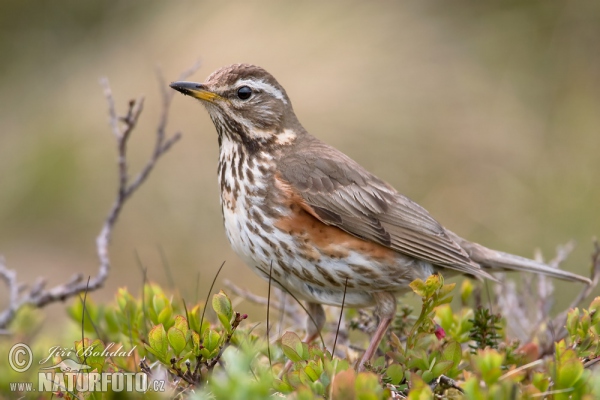
Its cousin the redwing is often the more numerous, traveling in large flocks and staying in close contact with each other. This smaller bird is very like a songthrush, but can be distinguished from it by the noticeable cream-coloured stripe above the eye. There is also a reddish patch under the wing which is very conspicuous in flight and which gives it its name. Even at night it can be identified as it flies overhead by its high pitched ‘tzeep’ call. Its Irish name is appropriately ‘deargán sneachta’ –or ‘the red snow bird’.

Neither of these thrushes breed here, but for the winter months watch out for them loosely scattered over the greener fields, hopping along and pausing now and again to pick up a tasty worm or other invertebrate. Fieldfare and redwing are often to be seen helping themselves to the bright red berries of hawthorn, yew and rowan. If you have had your eye on a beautiful sprig of holly flush with red berries for the Christmas decorations, only to go out one day and found it stripped bare, there is a good chance that the redwing or fieldfare have beaten you to it! They seem to be a lot more numerous this year. Their coming south equates to us heading off to the Riviera for a winter break!

May we at Cabragh Wetlands wish you all a very happy and peaceful Christmas, and take this chance to thank the many people who have supported our work over the course of the year.

Monday, December 14, 2009

Adaptation

Fr. SeánMcDonagh SSC December 10, 2009.

Last year at the Climate Change Conference in Poznan, Poland, I wrote an article about the importance of prioritizing the Adaptation Fund in any overall climate agreement. I made the point that reducing greenhouse gas emissions is the primary goal of the whole process. According to Article 2 of the UNFamework Convention on Climate Change (UNFCCC) the ultimate goal of the Convention is to achieve the “stabilization of greenhouse gas concentrations in the atmosphere at a level that would prevent dangerous anthropogenic interference with the climate system”.

However, it is important to remember that we are not talking about what may, or may not happen, in the future. In the 20th century average global temperatures increased by 0.74 degree Celsius, while sea-level rise, resulting from both the thermal expansion of the ocean and melting of ice across the globe, amounted to 17 cms. Even with a relatively small increase the Maldive Islands, several Small Islands states in the South Pacific and low-lying coastal nations such as Bangladesh, with lands surfaces barely a metre or two above sea level, would find that every storm and tidal surge represents a serious danger to human life. In fact, these areas may soon have to be abandoned by humans because they can no longer sustain human life.

So, Adaptation is designed to deal with the current and future casualties of climate change. From an ethical perspective it is about applying the moral principle that “the polluter must pay for the consequence of the pollution they cause.” Unless economically rich countries in Europe, North America, Japan, Australia and New Zealand and current major polluters such as China, India, Brazil and South Africa reduce greenhouse gas emissions within the next decade, then catastrophic climate change is almost inevitable and it will affect the poor more severely. Because Columbans are missionaries, much of our work on Climate Change is focused on the Adaptation measure because these will intimately affect people in many countries in which Columbans work, namely, Peru, Chile, Pakistan and the Philippines.

The Fourth Assessment Report from the Intergovernmental Panel on Climate Change (IPCC), was published in 2007, before the Bali Conference. One could summarize its finding with a few quotations from the document. It claimed that “Warming of the climate system is unequivocal as is now evident from observations of increases in global average air and oceans temperatures, widespread melting of snow and ice and rising global sea levels.” It goes on to link these changes with human activity, mainly the burning of fossil fuel to power our industrial economies, since the beginning of the industrial revolution,. “Most of the observed increase in temperatures since the mid-20th century is very likely due to the observed increase in anthropogenic greenhouse gas concentrations”.

Adaptation Fund received a lot of attention at both the Nairobi meeting of the UNFCCC in November 2006 and the Bali meeting in 2007. Disagreement centred around where the Fund would be located and how it would be managed. Economically rich countries wanted to have the Fund located in the IMF/World Bank complex, which would make it easier for them to control. This was anathema to many people from the South who suffered massive economic shocks as a result of the Third World Debt crisis in the 1980s and 1990s. Instead of attacking the banks that loaned the money or the governments that raised interest rates, the IMF/World Banks forced destructive Structural Adjustment Programmes (SAPs) that often crippled the education, health care and welfare systems of economically poor countries.

While the architecture of the Adaptation Fund was finally agreed at Bali, the main problem that Copenhagen has to tackle is simply that the needs are great and there is little money in the kitty. It is estimated that at least $100 billion annually will be needed by 2020.

A favourable outcome Copenhagen would involve: Firstly, a shared vision on Adaptation itself, which would take on board all aspects of the Bali Action Plan. This would mean a massive increase in designing Adaptation plans at the national and international levels. Secondly, rich countries must fulfill the promises they made 8 years ago to fully fund the actions which will address the immediate impact of climate change between now and 2012, when the Kyoto Protocol runs out. Thirdly, Adaptation funding must be new and additional to the Official Development Assistance (ODA) commitment of 0.7% of Gross Domestic Product (GDP) which the UN has called on all rich countries to make. The money must be delivered as grants and not as loans.

Setting the Stage for Copenhagen

Rev. Seán McDonagh, SSC December 8th 2009

This is my fourth time attending the Conference of the Parties (COP) to the UN Framework Convention on Climate Change (UNFCCC). My first one was COP 12, which took place in Nairobi in 2006. About 5,000 people were present at the event, including country delegates, people from civil society organisations and the media. We all gathered at the headquarters of the UN Development Programme (UNDP) in Nairobi. Security was tight and all events closed down before 6 p.m. I stayed at the Maryknoll house which is situated just outside Nairobi. As far as I can remember the only Head of State who attended, the president of Kenya.
The following year, COP 13 took place on the beautiful island of Bali in Indonesia. It was housed in a complex of luxury hotels close to the beach. Because of the nightclub bombings in Bali some years previously, security was very tight. About 8,000 people attended among them two heads of State, the President of Indonesia and the, then, newly elected Prime Minister of Australia, Kevin Rudd. The most memorable moment in Bali meeting happened on the last evening when the US delegation was attempting to derail what became known as the Bali Road Map. In exasperation a negotiator from the republic of Vanuatu called on the US delegation to, at least get out of the way, if they did not want to be party to the negotiation process. The Bush Administration was opposed to any globally binding climate change agreement. The Bali Road Map set out the programme of work which would have to be completed in order to deliver a follow-up treaty to the Kyoto Protocol at Copenhagen in 2009. The reason why a robust treaty is essential here at Copenhagen is that the Kyoto Protocol expires in 2012.

COP 14 took place at Poznan in Poland, in December 2008. I stayed at Capuchin monastery in the centre of the old city. On the first night one of the friars brought me for a tour and of the Christmas markets. I was particularly drawn to the ice sculptures, especially the intricacies of many of the designs. The Friar explained that traditionally these sculptures were carved in December and usually lasted through out the winter. In Poznan in December 2008, most of the sculptures had melted by the first Sunday of the Conference, a sure sign that climate change is already a reality. One of the disappointments of the Poznan’s meeting was the fact that European Union drew back from the commitments it had given at Bali, which was that rich countries, Annex 1 countries in the language of the COP, would reduce greenhouse gas emissions by between 25% to 40% by 2020. The row-back was as a result of pressure from the coal industry on the Polish governmentj and the fact that Chancellor Angel Merkel of Germany was facing re-election in 2009. She did not want to alienate the car, steel and coal constituency.

It is estimated that there will be 15,000 people at the Copenhagen Conference, including 100 Heads of State. The opening ceremony took place on December 7th 2009. It was addressed by the Prime Minister of Denmark, Mr. Lars Lokke Rasmussen, He said that COP 15 was taking place at a time of unprecedented political good will. He urged the parties to reach an ambitious agreement in order to deliver “hope for a better future” for all.

He was followed by the Executive Secretary of the UN Framework Convention on Climate Change, Mr. Yvo de Boer. He hoped that Copenhagen would result in an agreement on significant elements of the on-going negotiations. These include: Mitigation, which means cutting carbon emissions drastically in rich countries: Adaptation which involves making financial resources available to economically poor countries which are now and, in the future, will be badly effected by climate change; Initiatives to protect forests as carbon sinks and to make clean, non-fossil fuel technologies available to countries in Africa, South Asia and Latin America are also part of the negotiations. He emphasised that Copenhagen would be successful only if it delivered significant and immediate actions, beginning the day the conference ends
Madame Ritt Bjerregard, the Mayor of Copenhagen highlighted the Copenhagen Climate Summit for Mayors which will take place from December 14th to 17th 2009. She said that the city of Copenhagen aimed to be carbon neutral by 2025. She called on the negotiators to “go very far and very fast” and turn Copenhagen into “Hopenhagen.”

How Robust is the Science of Climate Change?

Fr. Seán McDonagh, SSC, December 9, 2009

In the run up to the Copenhagen Conference on Climate Change, hackers broke into computers at the University of East Anglia’s Climate Research Centre and got access to many private emails exchanged between climate scientists who have worked with the Intergovernmental Panel on Climate Change (IPCC). This ignited a global controversy about the reliability of the IPCC’s data and methodology. It forced the chief scientist at the centre of the row, Professor Phil Jones, to step down temporarily as head of the university’s climate research centre, while an independent enquiry into the matter was being conducted,
Many of these emails were seized upon by climate sceptics who claimed that scientists associated with the IPCC had excluded data from scientists who questioned the IPCC’s consensus that human-induced activities, especially burning fossil fuel, are significant elements in the current planetary global warming. News outlets such a Fox News in the U.S. and conservative politicians such as Senator James M Inhofe, the Republican Senator from Oklahoma, and Tony Abbott, the new leader of the opposition in Australia and Nigel Lawson in Britain claimed that the content of the emails vindicated their scepticism.
So, everyone expected that the chair of the IPCC, Prof. R.K Pachauri would deal with the issue at the first possible opportunity at the Copenhagen conference. At a meeting on the “IPCC Findings and Activities and their Relevance for the UNFCCC Process” on December 9th 2009, Pachauri addressed the controversy head on. He said that “it is unfortunate that an illegal act of accessing private emails communication between scientists who have been involved as authors in the IPCC assessment in the past has led to several questions and concerns. It is important for me to clarify that the IPCC as a body follows impartial, open and objective assessment of every aspect of climate change carried out with complete transparency.” He pointed out that “the IPCC relies mainly on peer reviewed literature in carrying out its assessment and follows a process that renders it unlikely that any peer reviewed piece of literature, however contrary to the views of any individual author, would be left out. Furthermore, “the entire report writing process of the IPCC is subjected to extensive and repeated review by experts as well as governments. Consequently, there is, at every stage, full opportunity for experts in the field to draw attention to any piece of literature and its basic findings that would ensure inclusion of a range of views.” He went on to emphasise that “there is no possibility of exclusion of any contrarian views, if they have been published in established journals or other publications that are peer reviewed.“
He was at pains to point out that the IPCC reports while using the best available science, are not completely dependent on scientists. “I would like to highlight the fact that the summary for policymakers of all the reports of the IPCC are accepted and approved by all the governments of the world.”
As a consequence of this painstaking and thorough process “no individual or small group of scientists is in a position to exclude a peer-reviewed paper from the IPCC assessment. Likewise, individuals and small groups have no ability to emphasize a result that is not consistent with a range of studies, investigations, and approaches.” There are many layers in the IPCC process, beginning with the large number of authors, from a wide range of scientific disciplines, who are involved in the writing process. On top of that, there is an extensive monitoring and review process and, finally governments sign off on the findings. As a result Dr. Pachauri rejected any biased findings. On the contrary he claimed that “the IPCC assessment Reports are comprehensive, unbiased and based on the best scientific data available at the time. Its findings can be relied upon and can form the basis for relevant policy decisions by policy makers. The remit of the IPCC does not allow it to become policy prescriptive.”

At the end of his statement he returned to the illegal hacking of private emails at the University of East Anglia. According to Pachauri the private emails have been taken out of their proper context. If I say, in a private email, that I could kill a particular scientist for writing a non-peer- reviewed, contrarian article about climate change, it doesn’t mean I plan to buy a gun and go out and shoot him. It means that I am as mad as hell, because I believe promoting non-peer reviewed, contrarian positions muddies the waters and slows down the possibility for the decisive actions which will be needed to stabilize atmospheric gases immediately. It is essential that these decisions are taken here at Copenhagen in order to avoid the worst consequences of climate change, which will affect the poor disproportionately. According to Dr. Pachauri the “incident only highlights the importance of IPCC procedures and practices and the thoroughness by which the Panel carries out its assessments.” Whether these answers will satisfy the sceptics or those sitting on the fence remains to be seen.

Updates from Copenhagen

We are delighted to have updates from Sean McDonagh from the Climate Change conference in Copenhagen which we will be publishing on The Snipe over the next weeks